An Historical Model for Creative-Critical Practice
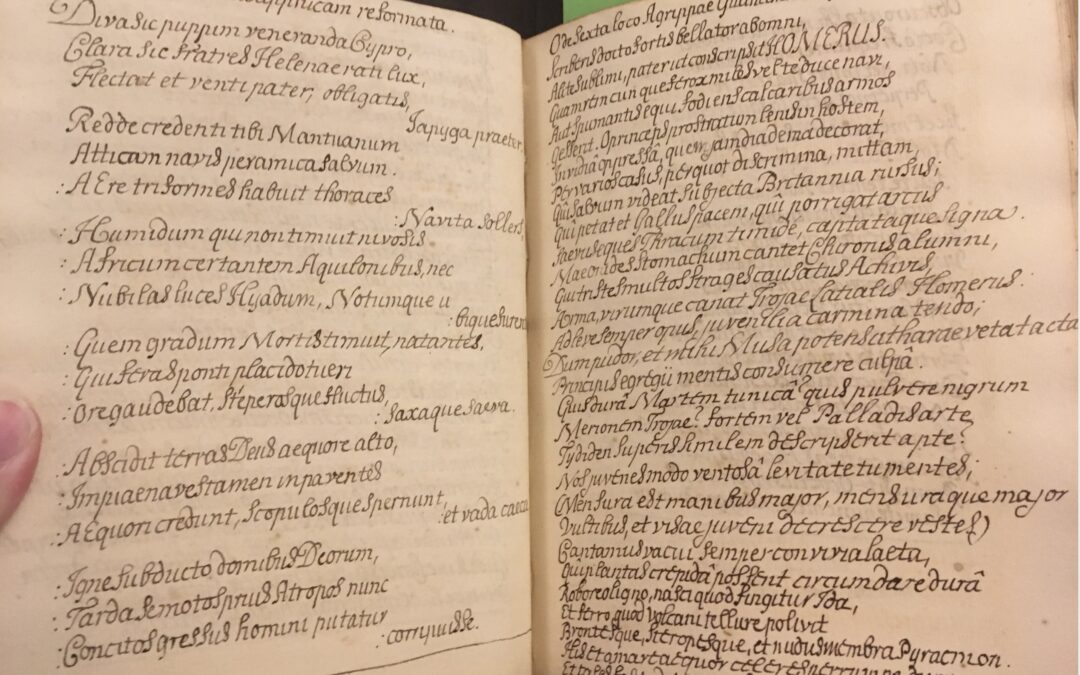
As Thomas Karshan points out in his essay on teaching through imitation, parody and play, the central aim of the Renaissance schoolroom was to teach boys to speak and write well in Latin.

As Thomas Karshan points out in his essay on teaching through imitation, parody and play, the central aim of the Renaissance schoolroom was to teach boys to speak and write well in Latin.
Harriet Parks, a teacher at Woodhouse College in Barnet, wanted her students to write in the voice of one of the characters in The Tempest as a form of imaginative, critical exploration of the play. To spur them on, and give them a sense of what was possible and what could be learnt about the play in the process, she wrote a monologue of her own in the voice of Miranda who has now returned to Italy with her father and Ferdinand. She also wrote an accompanying commentary explaining her choices and asked her students to do the same. Her monologue and commentary, as well as the student work, are a wonderful example of how much the creative-critical has to offer…
In 1979, the celebrated poet, scholar and critic, John Hollander took over the long-standing Daily Themes course at Yale and, drawing on his vast knowledge of literature, turned it into an outstanding example of a module in writing which is founded, in his words, on ‘a set of lessons about how to engage with past literature, past models of writerly practice, about how they teach us to write.’ We offer this course as a brilliant example for teachers wishing to bring together ‘criticism’ and ‘creative writing’, reading and writing – and especially instructive for the way it reflects Hollander’s unusually well-informed understanding of Renaissance teaching practices.
In Teaching through Imitation you will find an essay by Thomas Karshan on the history, theory, and practice of imitation in relation to his Ludic Literature MA module, an account by Will Rossiter of his use of imitation in his final-year undergraduate module ‘The Italian renaissance’, and an essay by Tim MacGabhann on the experience of studying literature through imitation.
By Jos Smith of UEA. In Speculative Nature Writing, you’ll find a creative-critical exercise designed by Jos, exploring how historical and personal attitudes to nature are registered in the forms and subgenres of nature writing. In The Poetics of Place, you’ll find an overview of the first half of Jos’s MA module of the same name, giving a sense of how a course on place writing might be structured to draw on both creative and critical ideas.
Recent Comments